




















Stake Sportsbook: Understand the Market Behind the Odds
A sports bet begins with a prediction, but its result depends on the exact market you selected. “Win the match,” “win in regulation time” and “qualify” can describe three different outcomes for the same team. Read the ticket as carefully as the price. This Stake sportsbook guide explains the terms, calculations and account records that make that possible.
Use the examples to understand the international product where lawful and available. They do not establish local access. Readers in India should start with the current restrictions; existing-account questions belong with official support.
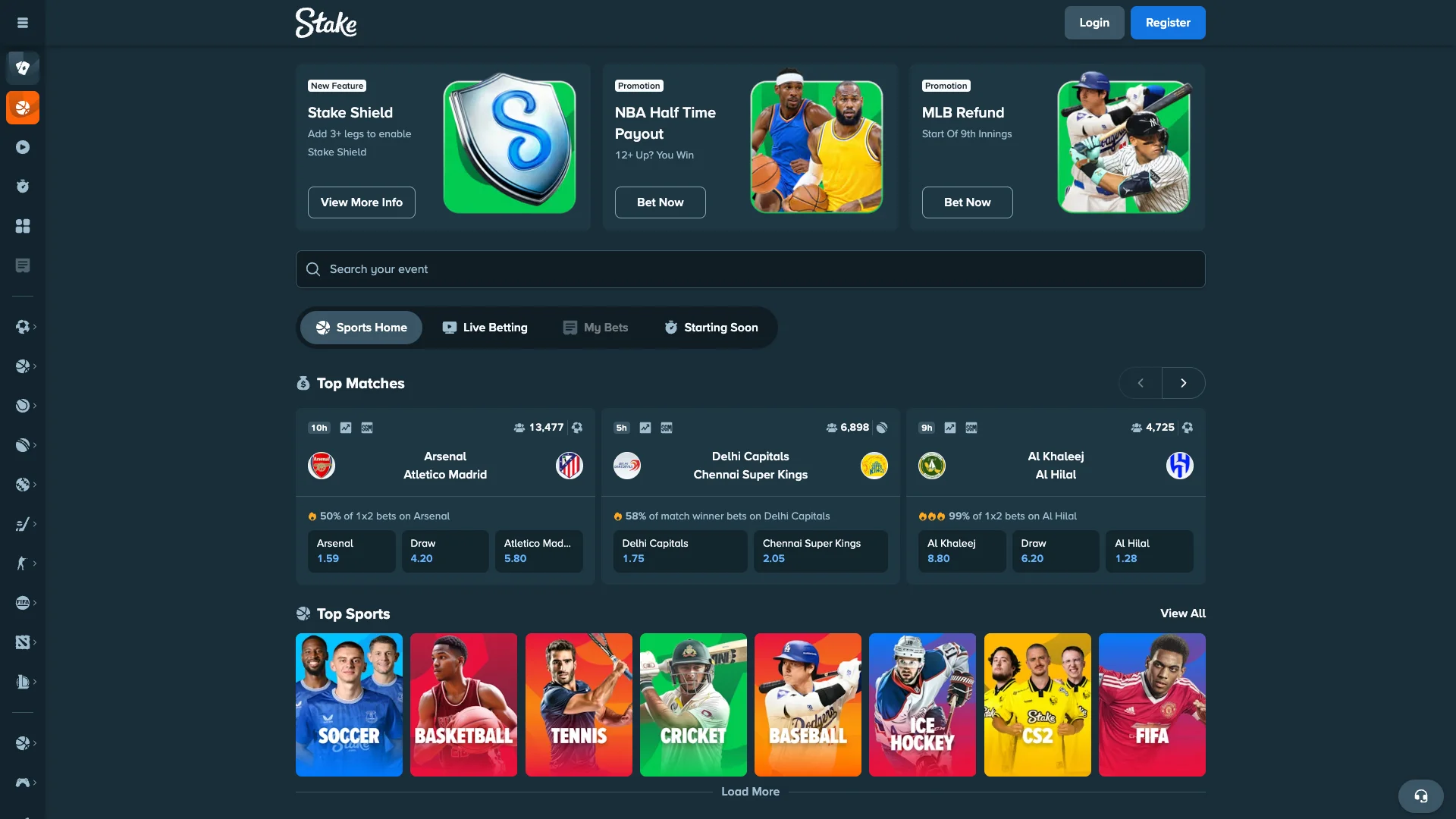
Choose the competition before the market
Find the sport, competition and event first. Confirm the participants and scheduled time. Similar team names, youth sides and reserve teams can appear close together in a broad event list.
Then open the market group you actually want. A prominent match-winner button does not summarise every market on the event. Player propositions, period totals and tournament outrights each define a different condition.
Availability changes with the schedule and account. Avoid using an old count of sports or live matches as a promise about today's screen. The useful question is whether the current event offers the exact market you understand.
Decimal odds: separate total return from profit
For an ordinary winning cash single, multiply the stake by the decimal price to find the total return. Subtract the original stake to find net profit.
At 2.75, a winning 12-unit stake returns 33 units; net profit is 21. The 33 includes the original 12. A free-bet promotion may handle the promotional stake differently, so use its separate rule.
| Stake | Odds | Total return on a win | Net profit on a win |
|---|---|---|---|
| 10 units | 1.50 | 15 units | 5 units |
| 10 units | 2.20 | 22 units | 12 units |
| 10 units | 4.00 | 40 units | 30 units |
You can also convert decimal odds into an implied probability by calculating 1 divided by the price. Odds of 2.00 imply 50% before accounting for the bookmaker's margin. That figure describes the offered price, not a guarantee about the event.
See the margin in a simple two-outcome example
If both sides of a hypothetical two-outcome market carry odds of 1.90, each implies about 52.63%. Together they total about 105.26%. The excess above 100% shows the overround in that simplified market.
Compare the same market and settlement rules when comparing prices. A higher price on a different outcome definition does not establish better value for the wager you intended.
Odds, implied probability and bookmaker margin
Decimal odds express the total return on a successful unit stake. Their reciprocal gives a simple implied probability before considering the bookmaker's margin and the market structure. Odds of 2.00 correspond to 50%; odds of 4.00 correspond to 25%. That calculation describes the price, not a verified forecast.
Consider a fictional two-outcome market with both sides priced at 1.90. Each price implies about 52.63%. Together they total about 105.26%, rather than 100%. The excess illustrates why displayed prices should not be read as a clean probability distribution.
Now compare a short price and a long price. At 1.25, a successful 10-unit stake returns 12.50 units, a 2.50-unit profit. At 5.00, the same successful stake returns 50 units, a 40-unit profit. The larger potential profit comes with a different market assessment of likelihood; it is not a free improvement.
Price changes also need context. News, time remaining and market activity can all accompany movement. A lower price after you place a bet does not alter the accepted ticket, while a higher price does not create a refund entitlement. Keep the accepted odds as part of the record.
Singles, accumulators and correlated selections
A single stands on one selection. An accumulator combines several legs into one ticket. Under a conventional all-to-win structure, every active leg must succeed for the ticket to win, subject to the applicable void and settlement rules.

For independent selections priced at 1.80 and 2.10, the simple combined price is 3.78. A successful 10-unit ticket would return 37.80 units. Adding another leg increases the quoted potential return while introducing another condition that can defeat the ticket.
Selections from the same event may depend on each other. A team's victory and a high score, for example, can be correlated. A Same Game Multi uses the platform's combined pricing rather than necessarily multiplying the individual prices you saw elsewhere.
Read the complete combined ticket. A void leg, non-participating player or unusual event outcome can trigger product-specific treatment. Do not assume an ordinary multi and a Same Game Multi resolve those cases identically.
Why adding selections changes the whole ticket
For independent decimal prices in an ordinary accumulator, the combined price is the product of the included odds, subject to the operator's rules. Three fictional selections at 1.50, 1.80 and 2.00 produce a price of 5.40. A successful 10-unit ticket would return 54 units including the stake.
That arithmetic can make the ticket look attractive, but every required selection must satisfy its conditions. If one ordinary leg loses, the accumulator normally loses. A void leg may be treated differently under the rules, and a same-game product can have its own treatment.
Correlation is another reason not to multiply every pair of prices by hand. Two selections within the same event may be related. A team winning and that same team scoring many goals are not independent propositions. A same-game builder can price their combination differently from a simple product.
When a leg is voided or an event is postponed, read the accepted ticket and the relevant rules. Do not reconstruct the final return from memory. Save the original selections, odds and settlement labels so that a change can be explained precisely.
A larger combined price also makes the ticket more sensitive to one misunderstood condition. Read each leg as carefully as a single, particularly when it concerns a player appearance, a specific period or a competition format.
Handicaps: apply the line before deciding the result
A handicap adjusts the relevant score for settlement. Write the adjustment beside the selection and apply it to the final result for that market.

With a hypothetical −1.5 goal handicap, the selected side needs a winning margin of at least two goals. A one-goal victory wins the ordinary match-result selection but loses that handicap. The team winning and the bet winning are different questions.
Whole-number lines can produce a push under the applicable rules. A half-point line removes an exact tie at that line. Quarter lines can split a stake across adjacent lines; read the market explanation before using them.
Check the period too. A first-half handicap uses that half's score, not the final match score. A market that includes overtime needs its own explicit definition.
Totals need a period, a unit and a line
An over/under market can concern goals, points, runs, corners, maps or another statistic. Confirm the unit and whether the market covers the whole event or one period.
For a hypothetical total of 2.5 goals, three goals satisfy the over and two satisfy the under. A total of 3.0 may allow a push at exactly three under the stated rules. The decimal in the line changes the settlement possibilities.
Player totals can require participation or a particular role. Read that condition before assuming a player who never enters the event simply produces a zero. The rules may instead void the wager.
Handicaps and totals through simple examples
A handicap changes the comparison used to settle a market. In a fictional two-way match market, a team at minus 1.5 must win by at least two goals for that selection to succeed. A team at plus 1.5 can lose by one goal and still satisfy that handicap. The match winner and handicap winner can therefore differ.
An integer line can introduce a push under the applicable rules. At a total of 2.0 goals, a match ending with exactly two goals may return the stake, while over 2.5 requires at least three. Always read the market type and settlement rules instead of assuming every total behaves like a half-point line.
Quarter lines split the stake across adjacent lines. As a purely illustrative example, a line of 2.25 can divide a stake between 2.0 and 2.5 under the relevant market rules. One part can push while the other loses, creating a half-loss result. The ticket's exact terms determine the treatment.
Periods matter too. A first-half total is settled from the first half, even if the full match later becomes high scoring. A team total concerns one side, while a match total combines the relevant scores. The number alone is not enough to identify the wager.
Live betting: three clocks can disagree

Your video feed, the displayed score and the bookmaker's market can update at different times. That delay matters most around decisive events such as a goal, wicket or set point.
A tap on a price starts a submission process. Inspect the final price and any acceptance setting, then check the accepted bet record. The quote you first saw does not prove what the system accepted.
Markets can suspend during significant action or data interruptions. A greyed-out button is not necessarily a fault on your phone. Wait for a clear status and avoid repeatedly submitting a selection whose state you cannot read.
If the connection drops, inspect My Bets or the equivalent account history before repeating the wager. A missing animation does not establish that the first submission failed.
Live scores, streams and the accepted-bet record
A live interface can display a score feed, a clock, video and prices simultaneously. Those elements may not update at precisely the same moment. A broadcast delay means that a viewer can be watching an earlier event while the market has already reacted.
When submitting an in-play selection, inspect any acceptance message and then the final ticket. A request can be pending, rejected or accepted at the conditions shown in the confirmed record. The fact that a button was tapped does not establish an accepted wager.
If the price changes before acceptance, the interface may require a decision according to its settings. Understand any option that accepts changed odds automatically. A preference concerning price movement affects the submission process; it does not guarantee that the original displayed price remains available.
Keep a stable view of the complete market name on mobile. A shortened label can conceal the period or line. Before confirming, expand the bet slip if necessary and verify the stake, potential return and selection scope.
For a dispute, record the accepted ticket identifier and time. A screenshot of a live scoreboard can provide context, but the ticket establishes what was actually agreed. The operator's settlement source and rules explain how the result is determined.
Cashout is an offer that can disappear
Cashout provides a quoted amount to settle an eligible ticket before its ordinary conclusion. The operator does not promise that every event or market will offer it at every moment.
The amount can fall below the original stake or exceed it. Compare that amount with your initial cost, and remember that the ticket's remaining possible payout is uncertain. Clicking an offer does not guarantee acceptance if the price changes or the market suspends during processing.
Stake's rules describe specific exclusions and conditions, including treatment of Same Game Multis. Read those rules for the ticket you hold. A cashout button that appeared earlier does not create a guaranteed exit later.
After an accepted cashout, keep the account record. If the value seems wrong, send the ticket reference and the relevant timing to support instead of relying only on a screenshot of an earlier offer.
Compare a cashout amount with the original stake
Cashout presents an offer to settle an eligible ticket early under the product's rules. The displayed amount is a total amount offered for closing the relevant position, not automatically a profit. If a 20-unit stake receives a 13-unit cashout offer, accepting it would realise a 7-unit loss on that ticket.
Conversely, an offer of 26 units on the same stake represents a 6-unit gain if successfully accepted. Compare the confirmed result, not merely the amount visible before pressing the button. The offer can change or become unavailable while the underlying event changes.
Availability depends on the product and market. It should not be treated as a guaranteed exit plan for an accumulator, an interrupted match or a particular same-game ticket. A ticket can remain open even when the customer would prefer to close it.
Partial and full settlement features, where offered, also need their own reading. Understand whether part of the original exposure remains. A reduced position is not the same as a fully closed ticket, and the account history should show the distinction.
Cricket deserves its own market check
Format changes the event. A T20 match, an ODI and a Test create different roles for time, innings, weather and draws. Identify the format before comparing odds.
For a runs total, identify the team, innings or over. For a match-winner selection, read the treatment of ties, official results and interrupted play. A rain-adjusted match can affect one market differently from another that already reached a definite outcome.
The cricket guide works through these distinctions, including player markets, toss information and settlement questions. Use the live event page for current fixtures and prices.
Esports: a match is not always a single game

In a best-of series, match winner and map winner refer to different scopes. A team can lose the opening map and still win the series. Check the scheduled format and the selected map number.
Titles such as Counter-Strike 2, Dota 2 and League of Legends use different statistics and competitive structures. A rounds market in one title does not correspond to a kills market in another. Read the unit and period in the selection.
Roster changes, forfeits, technical interruptions and format changes can trigger special rules. Treat tournament data and official settlement conditions as separate from a commentator's prediction.
Team branding does not establish a betting advantage
You may encounter esports partnerships or team-led promotions around a bookmaker. Confirm any current campaign through the official announcement. A commercial relationship does not make the team's next result more predictable or guarantee a better price on its matches.
Assess the market independently. Your familiarity with a team's name can make a selection feel easier to understand than its actual probability warrants.
Football, tennis, basketball and esports need different checks
Football markets can distinguish regulation-time results, extra-time outcomes and qualification. A team progressing after penalties does not necessarily make a regulation-time selection successful. Read the market title and the event rules together.
Tennis introduces retirements, walkovers and match-format questions. A match-winner market and a completed-set market can be treated differently when play stops early. Check the specific retirement rule rather than assuming every incomplete match is automatically void.
Basketball can distinguish regulation time from a result including overtime. Team totals, player statistics and period markets each need the correct scope. A final scoreboard does not by itself reveal how a first-quarter or regulation-only ticket should settle.
Esports requires the game title, competition, series format and map scope. A series winner, an individual map winner and a round handicap describe different events. Team names can remain familiar while rosters, formats and map selections change, so identify the exact fixture in the ticket.
The sportsbook's breadth is useful for navigation, but it increases the value of sport-specific reading. A settlement habit learned in one category can be wrong in another. The dedicated cricket guide handles rain, innings and Super Over distinctions separately.
Read sports promotions alongside the ticket
Inspect qualifying odds, minimum stake, eligible competitions and the required settlement time. A promotion can exclude particular markets or treat cashout as a disqualifying action.
For a free bet, check whether the promotional stake returns with winnings. For an odds boost, check the maximum stake and exact boosted selection. For a protected multi, read what the protection actually returns and what it costs in price or conditions.
Do not calculate a reward from the banner alone. Our bonus guide gives examples that distinguish cash returns, promotional credits and conditional protection.
Fund and settle the account through compatible routes
The sportsbook uses the operator's account and wallet system. Before any permitted funding, identify the asset or local payment route, the fees and the corresponding withdrawal options.
A displayed INR equivalent does not establish Indian payment availability. A cryptocurrency balance does not remove location restrictions. Use the wallet and current account guidance, then consult the payment overview for the mechanics.
Keep deposits, withdrawals, bonuses and bet results separate in your own records. A balance change can include several of those events at once; reading only the final number can obscure what happened.
When an event changes or a result looks wrong
Open the rule for the sport and market. General postponement rules can yield to a sport-specific condition. A market whose outcome already became definite can receive different treatment from an unresolved market in the same abandoned event.
Compare the accepted ticket, official event result and applicable rule. Save the bet ID, selection wording, line, price and timestamp. Explain the discrepancy in one sentence, then provide those records.
For example, saying “this ticket concerns the first innings total, but the explanation refers to the match result” identifies a concrete issue. Saying “the settlement is unfair” leaves the market itself unclear.
Ask support to identify the rule it applied. Keep the case reference and follow the operator's complaint procedure if the explanation does not resolve the discrepancy.
Review an unexpected result systematically
Begin with the market name exactly as accepted. Identify the period, line, participant and any special condition. Then compare the relevant official result, not a headline that describes a different scope. A match report may emphasise the eventual winner while the wager concerns regulation time.
Next, inspect the settlement label: won, lost, void, push or another product-specific result. Recalculate the return using the accepted stake and odds. For a multi, check whether any leg was removed or adjusted under the rules.
If the result still appears inconsistent, send one focused request with the ticket identifier, the rule you believe applies and the discrepancy. Avoid combining unrelated tickets into a vague complaint. A clear example gives support a concrete decision to explain.
Retain the response with the ticket record. Understanding why a market settled in a particular way is useful even when the outcome is unfavourable. It improves future reading of the product without implying that any method can guarantee a profitable result.
Judge results over a complete record
Record stakes, returns and net results consistently. Count losing tickets alongside winning ones, and separate deposits from profit. A large payout screenshot can conceal a larger total stake.
Set a spending and time boundary before the event. Do not increase the stake because a previous ticket lost or because the next match offers a familiar team. Neither circumstance improves the next selection's probability.
Keep the experience manageable on mobile: expand truncated market names, check the final ticket and avoid rushing between live video and confirmation screens. Clear records matter more than fast taps.
A small ticket ledger that separates exposure and results
Consider three fictional singles of ten units each. The first wins at decimal odds of 1.80, the second loses and the third remains unsettled. The first returns 18 units, creating an eight-unit profit on that ticket. The second creates a ten-unit loss. The settled result is therefore minus two units, while another ten units remain committed.
It would be misleading to call the unsettled ticket either a loss or a future win. Its potential return is conditional. The available wallet balance, settled profit and open exposure are three different measures that should be recorded separately.
Now suppose the third ticket is voided under its applicable rule and the ten-unit stake is returned. That return restores committed funds; it is not ten units of profit. Across all three tickets, total stakes were 30 units and returns were 28, leaving a two-unit net loss.
If a promotional credit later adds one unit, record it separately. The wallet's overall change becomes different from the betting result, but the ticket calculations remain the same. This makes it possible to evaluate the reward without rewriting the sporting outcomes.
A simple ledger needs the event, market, stake, accepted odds, status and return. Add the ticket identifier so an unexpected result can be traced. There is no need to collect every live price movement unless it is relevant to an acceptance dispute.
Reviewing this record can reveal a misunderstood market or an arithmetic error. It cannot prove that a short winning sequence will continue. The value of the ledger is accurate accounting and clearer questions, not a guarantee of future performance.
A final reading of the bet slip
Before an eligible wager is submitted, the bet slip is the place to check the complete contract in one view. Confirm the event, participant, market, line, period, stake and price. A selection that looked clear in a crowded event list can reveal an important qualifier when expanded.
For example, “Team A to win” could refer to a particular period or a qualification market depending on the actual label. A total might concern one team rather than both. A player statistic can require participation under a specific rule. The familiar name is only one part of the selection.
Review any price-change preference as well. If the interface offers automatic acceptance of changed odds, understand what that setting permits. The confirmed ticket remains the record of acceptance, but the preference can affect how the request reaches that state.
Check the difference between stake and potential return. A ten-unit selection showing a potential return of 25 units represents a possible 15-unit profit, not 25 units of profit. On a multi, confirm that every intended leg appears and no unintended selection remains from an earlier browsing session.
After submission, verify the ticket identifier and status. A button press followed by a loading indicator is not the same as a confirmed accepted wager. If the connection interrupts the sequence, inspect history before trying again.
This final reading is a practical interface habit, not a method for predicting results. Its value is preventing avoidable misunderstandings about what was selected and preserving a clear record for later settlement review.
Stake sportsbook questions
Does decimal return include the original stake?
For an ordinary winning cash wager, yes. Subtract the stake to find net profit. Promotional free bets can use different rules.
Can the same team win the match while your bet loses?
Yes. A handicap, period market or player proposition can have a different winning condition from the final match result.
Does a live stream show the same moment as the market?
Not necessarily. Feeds and market updates can have different delays.
Can you rely on cashout being available later?
No. Availability depends on the event, market and current state, and an attempted cashout may not complete.
Do all abandoned-match bets become void?
Use the sport and market rules. Some outcomes may already be definite, while others remain unresolved.
What is the best evidence for a settlement question?
Provide the accepted ticket reference, exact market wording, official result and rule you believe applies.
About this guide
Garry Anderson · Editorial author
This independent guide combines product explanations, worked examples and references to the operator's documentation. Numerical scenarios illustrate the rules; they do not describe a promised result or a new live-account test.
View the reference materialReferences and product documentation
Reference review: 26 September 2026. Consult the current account interface and applicable rules for changing details. The examples on this page do not represent a personal offer.